
When AI Chooses Your Brand, Or Doesn't
AI already acts as the intermediary between discovering and recommending brands, backed by real data from Amazon, OpenAI and Google. What it means for brand strategy, and what business leaders should do about it now.
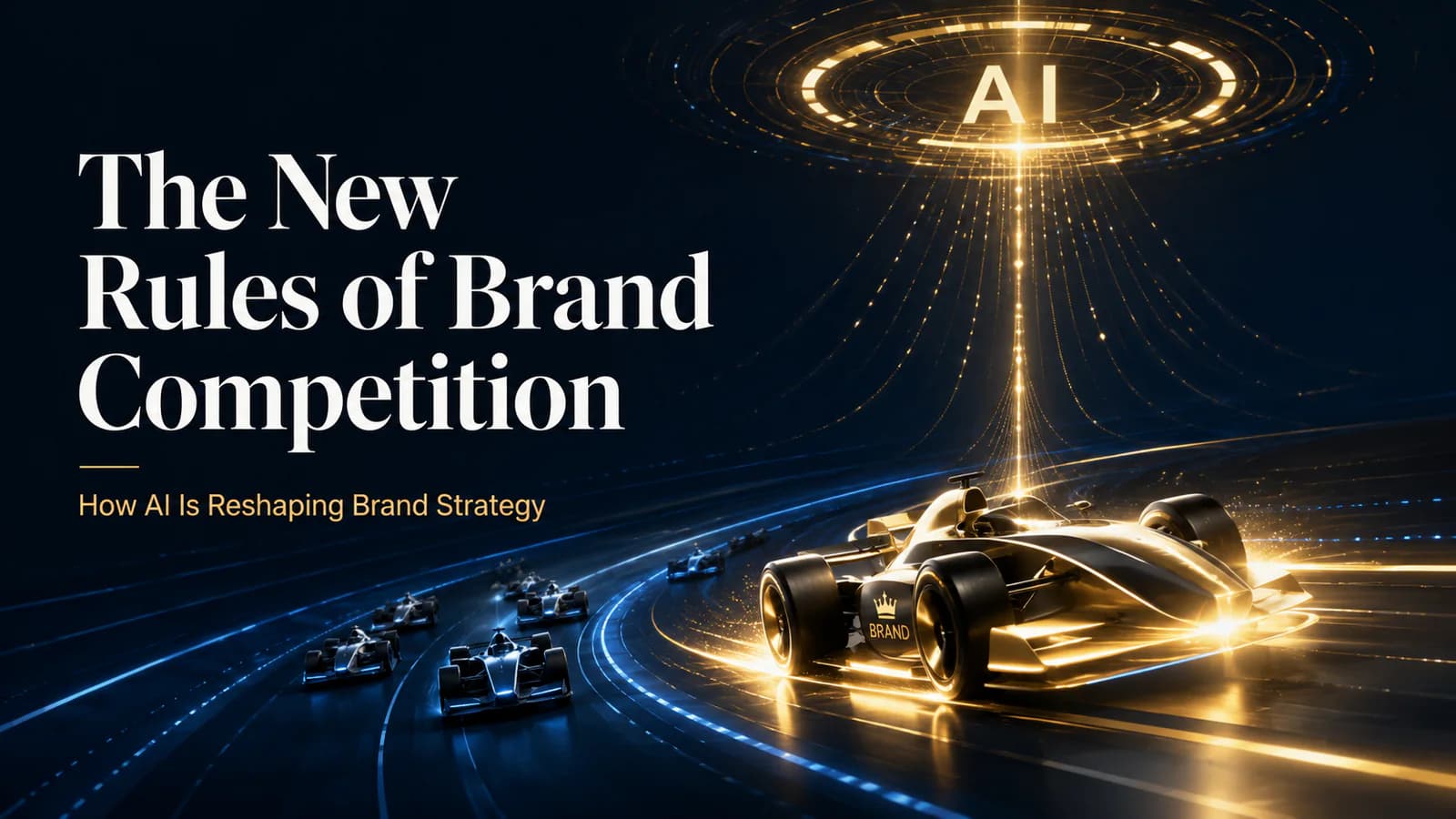
The guest nobody invited to the conversation
I was recently reviewing a client's brand positioning at TOTEM when a question hit me with a clarity I hadn't quite had before: who are we actually building this brand for? The obvious answer was "the people who will buy it." But the more I sit with that answer, the more incomplete it looks. It's increasingly common that before a person gets to compare two brands on their own, an AI system engages first with whoever has the question and hands them a definitive conclusion instead of a list of options. That has a double implication: it's no longer enough to be a good brand that simply isn't well positioned, because that now means falling out of the conversation without anyone noticing; on top of that, the purchase decision stops resting solely with the person and starts being shaped by whatever a language model decides to show them.
This is already happening, at a scale that surprises even people who work on this daily. Amazon has stated that its AI shopping assistant, Rufus, was used by more than 300 million customers in 2025 and helped generate close to $12 billion in additional sales for the company, according to figures Amazon itself shared in its earnings (Modern Retail; Yahoo Finance). Customers who engage with Rufus during their shopping journey are 60% more likely to complete a purchase than those who don't. This is already part of the customer journey for millions of people in the largest marketplace in the world, and it has slipped into the purchase process almost naturally, without asking permission. The main beneficiaries are both users and Amazon itself: people save time and feel their search is better tailored to what they need, and Amazon sells more. The ones who lose out are mid-sized and small brands, which risk going from being seen to becoming invisible inside that same marketplace.
That uninvited guest in the conversation between a brand and the person who might buy it is the subject of this piece. That's why leaders, brand leaders especially, but really everyone across an organization, need to start reviewing both their strategy and their growth projections. Meanwhile, many companies are probably ignoring it, as if none of this were happening, letting themselves get carried by a wave that might lift them, but that's more likely to end up sinking them.
Brand strategy was designed for a human-only market
Everything we know about building brands (positioning, identity, awareness, trust, preference) was designed for a market where the only entity capable of deciding was a human being. Classic brand equity models measure:
- How well people remember you.
- What your brand means to them.
- How much they're willing to prefer you over the competition.
And they've spent decades proving that's exactly what you need to optimize to win in this market.
None of that stops being true. People will keep preferring brands for emotional, cultural and identity-driven reasons, and that remains the heart of any serious brand strategy. The problem is that, for the first time, human preference is no longer the only variable deciding whether a brand not only enters consideration, but actually shows up as a real option for the person who ends up paying for the product or service.
Changes to consider as AI becomes the intermediary
When an AI assistant answers, it has already compared brands and delivers a conclusion based on whatever data the model holds as its knowledge base, almost always narrowed down to very few options, unless the person explicitly asks for more. That means we're moving from a phase where any brand could show up to one where the funnel closes much further, and only a handful of brands, likely paying for that visibility or deeply faithful to their value proposition and differentiation, will get mentioned.
The question brand teams need to start answering today is different, and considerably less comfortable: it's no longer how do we show up in the results, but why would an AI system recommend us? The filter moved upstream, and brands that aren't ready for that filter simply never get the chance to make their case with their own brand narrative.
This also lines up closely with what you see in business school and, increasingly, in practice: we're moving from analyzing direct competitors, like Coca-Cola and Pepsi, to actually analyzing customer needs. An AI system doesn't compare brands simply by industry or product type, it compares them by whichever option best solves what the person needs in that moment. That's exactly why branding gains value instead of losing it: answering those needs directly can end up being what decides whether your brand gets chosen. The market stops being the market for carbonated drinks and becomes the market for get-togethers, the market for refreshment, the market for a good time. And that's precisely the moment brands leave the realm of advertising and enter the realm of reality, where you can see whether their value proposition and brand promise actually hold up or not. Being coherent has never been more valuable than it is now.
What's already happening, backed by real data
I'd rather not stay in the theoretical, so let's go straight to data from well-known brands.
The first is OpenAI and Stripe's attempt to resolve the purchase inside the conversation itself. In September 2025 they launched the Agentic Commerce Protocol (ACP), an open standard that lets people buy without leaving ChatGPT, with more than a million Shopify merchants as early partners, and Target, Sephora and Nordstrom joining afterward to at least appear in discovery (OpenAI; Stripe). Walmart was among the first to test it seriously, making 200,000 products available to buy directly inside the chat. The result was revealing, though it's worth translating it properly: purchases people made inside ChatGPT converted at a third of the rate of purchases that went through walmart.com first, meaning people arriving via ChatGPT ended up buying far less than people who went directly to Walmart's own website. Daniel Danker, Walmart's EVP of product, publicly called that experience "unsatisfying" (MarTech). It was, at bottom, an experiment that didn't fully work, and it led OpenAI to reposition ChatGPT as a discovery layer rather than a full purchase channel, letting each merchant control its own checkout. The lesson is that the mature version of all this splits apart two things that initially looked like one: where you get discovered and where you get bought. Being seen is already as important as having a good product, for people to actually buy it.
The second episode is Google. When an AI Overview appears (the AI-generated summary Google places above search results), the click-through to organic results drops sharply: from 1.62% to 0.61%, meaning it shrinks to a bit over a third of what it normally is, according to a Seer Interactive study covering 53 brands and 5.47 million queries (Search Engine Land). An independent field experiment also found a 38% drop in organic clicks on queries where one of these summaries appears (Search Engine Journal). Put simply: when Google answers for you, far fewer people end up clicking through to a website, yours included.
That same Search Engine Land study finds signs of recovery between December 2025 and February 2026, suggesting the market is readjusting rather than the organic click disappearing for good.
And here a little humility about predictions is warranted too: in 2024, Gartner forecast that traditional search volume would fall 25% by 2026 as conversational assistants gained ground (Gartner). By mid-2026, the broader assessment is that the drop didn't happen at that magnitude: search is evolving, not collapsing. I mention this not to downplay the phenomenon, but because it's worth separating what can already be measured from what's still a projection, especially on a topic where it's easy to get carried away by the most alarmist, sensationalist or straight-up hype-driven headline.
The AI-Era Brand Advantage Model
These episodes point to a pattern that can be summarized in a single framework, and it's the central argument of this piece:
Brand advantage = Human preference × Machine legibility × Delivery confidence
The multiplication sign isn't decorative. It's the most important part of the model, because it means none of the three dimensions fully compensates for the other two.
- Human preference: whether people know, trust and want the brand. It's the brand wanted by people.
- Machine legibility: whether AI systems can accurately understand what the brand is, what it offers, and what makes it genuinely different. It's the brand understood by systems.
- Delivery confidence: whether the company consistently delivers the price, availability, quality and service that AI might use to decide whether to recommend it. It's the brand validated by reality.
The AI-Era Brand Advantage Model
Wanted by people
Human preference
Whether people know, trust and want the brand.
Understood by systems
Machine legibility
Whether AI can accurately grasp what it offers and what makes it different.
Validated by reality
Delivery confidence
Whether the company consistently delivers what it promises.
If one of the three dimensions is weak, the brand's total advantage drops significantly.
A brand deeply loved by people, but invisible or poorly represented to AI systems, loses a growing share of the market without fully understanding why, the same way Walmart discovered that being present inside ChatGPT wasn't enough if the purchase experience in there didn't hold up.
A brand highly visible to AI, but without real emotional connection, doesn't generate lasting preference: only cold, easily substitutable transactions.
And a brand with an attractive identity that fails to deliver what it promises gets exposed more than ever, because comparing no longer costs time or even much effort.
Why current brand strategy may fall short
The most common weakness I see, inside and outside TOTEM, is generic language. "Innovative," "customer-centric," "sustainable," "trustworthy" were already weak words for people, because any competitor can claim them without anyone noticing the difference. For an AI system that needs distinguishable, verifiable signals to justify a recommendation, that language is even less useful.
Add to that fragmented information: product data on one site, reviews scattered across another, brand communication that doesn't always reflect day-to-day operational reality. And the deeper issue, the one that concerns me most: the gap between what the brand promises and what the company actually delivers. That gap always existed, but it used to be expensive to detect, since comparing properly took a person time and effort. Now, with an AI system in the loop, comparing is instant and free, so that gap becomes visible far sooner and with far more consequences.
There's an additional risk worth naming clearly: platform dependence. The more purchase decisions lean on assistants, conversational search engines or recommendation systems, the more companies will discover they have less control over how they're represented than they assumed. A brand can have excellent awareness and still have very little real influence over the information an AI system uses to describe or compare it. Knowing where that information originates, who controls the customer touchpoint, and which sources the system treats as authoritative is, in itself, a strategic decision.
An honest self-audit for the leadership team
Before moving to the action agenda, it's worth asking a few uncomfortable questions, because most companies have never framed them this clearly:
- If we ask ChatGPT, Gemini or Claude directly about our company, do they describe it accurately? Does it match how we want to be described?
- When someone asks an AI system for a recommendation in our category, do we show up? And if we do, in what position and with what nuance?
- How much of what we say about our brand is backed by verifiable evidence, and how much is just marketing language?
- How dependent are we on external platforms to reach the customer, and what would happen to our visibility if that platform changed its rules tomorrow?
- Is there a real operational failure (delivery, service, availability) silently contradicting our brand promise?
None of these questions has a comfortable answer on the first try. That's precisely the sign that they're worth asking. I turned these questions into a scored checklist with a verdict: Is Your Brand Ready for AI?
What business leaders should do now
You don't need all the answers to start moving. A concrete agenda:
- Audit how AI systems currently describe and recommend the brand, comparing that description with the one the company would want to project.
- Clarify the brand's distinctive, verifiable attributes, setting aside the generic adjectives any competitor could claim just as easily.
- Improve the structure, consistency and accessibility of brand information across every channel where an AI system might find it.
- Identify which operational signals support the brand promise, and which silently contradict it.
- Strengthen third-party references with real authority: press, serious comparisons, certifications, verifiable case studies, not just self-authored testimonials.
- Bring brand, SEO, ecommerce, data, technology and customer experience into the same strategic conversation, something that in most companies today remains a set of separate conversations that barely talk to each other.
- Decide, deliberately rather than by inertia, which parts of the brand should stay deeply human and which need to become machine-legible.
What should never be automated away
I'll close with what I think is the most relevant point in this entire piece. Precisely because comparing on features and functionality becomes instant and direct, what makes a brand chosen, remembered and, above all, loved, goes well beyond its price or technical specification.
Real emotional connection, culture, the identity a brand conveys and the meaning it represents don't compete with AI, as long as they're visible. They are, precisely, what AI struggles to replicate, no matter how sophisticated, complex or powerful the system becomes. If we treat brands purely as an algorithmic visibility problem, and forget why they exist or why people prefer them over the rest, we'll be giving up the very essence of what actually makes the difference: the hardest thing to copy, and the most valuable at the same time.
The brand that wins over the coming years will be the one that achieves all three things at once: the one understood by AI systems, the one validated by the reality of what it promises and ends up delivering, and above all, the one that earns people's genuine love for the brand itself.
Comments
Leave a comment
Did this resonate?
Get notified when I publish something new on the blog or in resources. No spam, only when there's something worth it.
You'll get an email to confirm. You can unsubscribe whenever you want.
Related posts
Educating When Everything Feels Lost
A reflection on attention, effort, learning and resilience in a world where technology removes friction but cannot learn on our behalf.
The window is closing: OpenAI, Google and Anthropic signed the same letter on the same day
More than 100 organizations that compete with each other signed the same warning about AI-enabled cyberattacks. What it says, why now, and what it means for your company.
The best way to learn is by doing
There is no shortage of AI courses and guides, but they expire fast. Why being self-taught went from unusual to essential, and what five months at the gym taught me.
Found this useful?
If you'd like to discuss this topic at your company or event, I'd love to hear from you.
Contact me