
What Happens to Us When We Outsource Parts of Our Intelligence
A personal reflection on the possibilities and risks of seeking comfort and efficiency through artificial intelligence.
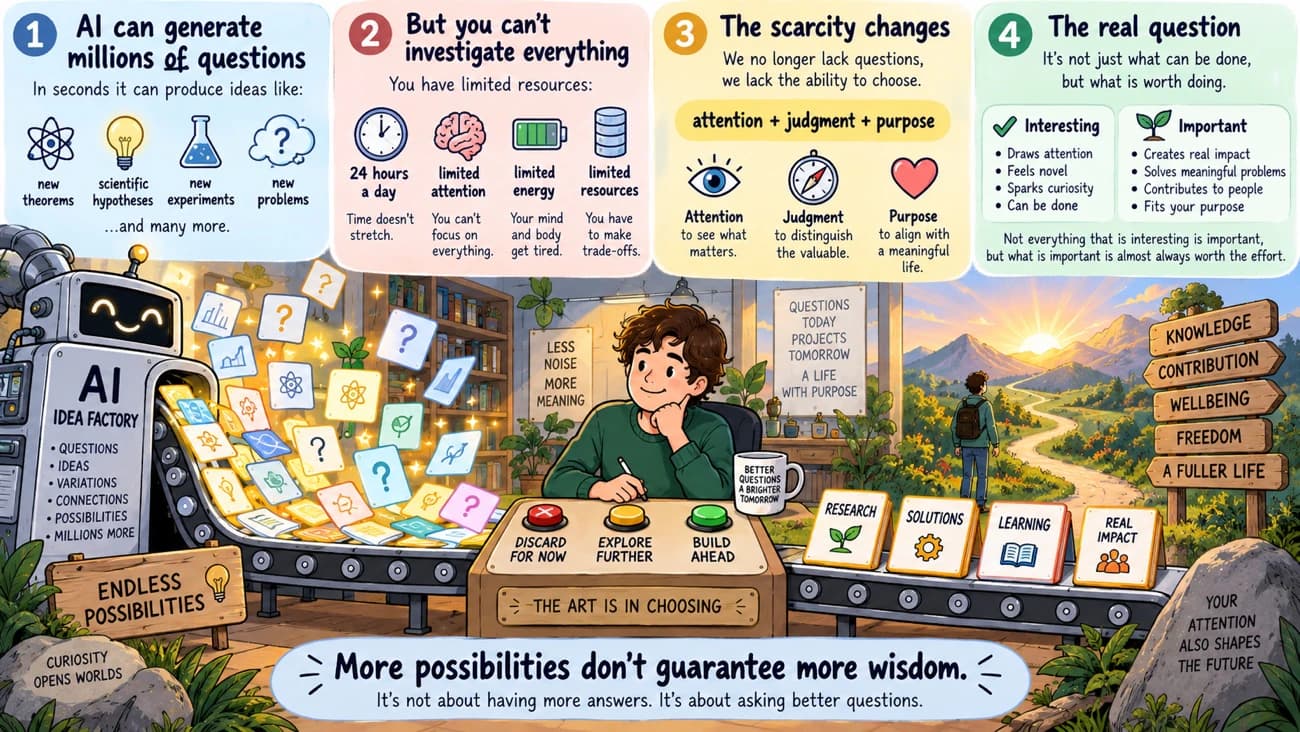
This morning I was reading about how AI is affecting career growth for Gen Z.
In Deloitte's global survey of Gen Zs and millennials, one in four young people said AI could accelerate their career growth and help them gain experience faster. At the same time, an article from the World Economic Forum discussed how people at the start of their careers are being given greater responsibility much earlier, with all the good and bad that can bring.
I saw two sides to this.
On the positive side, I see and hear how difficult it is for people from my generation to progress professionally. You only have to open LinkedIn to find more than 100 applicants for any attractive position barely two hours after it was posted. Competition is fierce and, sometimes, seeing the person next to us as a threat creates situations that are not pleasant at all.
If AI allows someone from Gen Z to take on a position of responsibility earlier and perform it well, I think that is great news. It could help more young people reach leadership positions in important companies and open opportunities for others who are still struggling to find them.
On the other hand, the idea makes me hesitate.
Technology giving people more confidence to do their jobs is positive. But if that confidence comes from being able to do things we do not fully understand, I think we need to be careful.
We are at a point where training and knowledge feel more relevant than ever. Because this is where AI really can perform “miracles”.
Doing Something Is Not the Same as Understanding It
If we take on something we know little or nothing about, then no matter how powerful the AI is, the result will still be relatively standard.
It is the same with anything. If we want to be fit but never train, pay no attention to what we eat and follow an unhealthy routine, we are unlikely to achieve our goal.
In a business context, imagine I was asked to analyse the aviation industry within four days, having never seen anything like it before. I could use ChatGPT to produce a good report. But being able to defend that report, or to put my own judgement into it, is something else entirely.
The same applies to decisions. If we move from a role with no responsibility into one where every day brings a different risk, we will probably feel overwhelmed and place ourselves under unnecessary pressure.
AI can advise you, but if it makes a mistake or you make a bad decision, the responsibility falls on you. And when you ask the AI about it afterwards, it will probably say something like: “Oh, I'm so sorry. You're right, I made a mistake. I regret the error. Would you like me to give you three alternative options so that it goes better next time?”
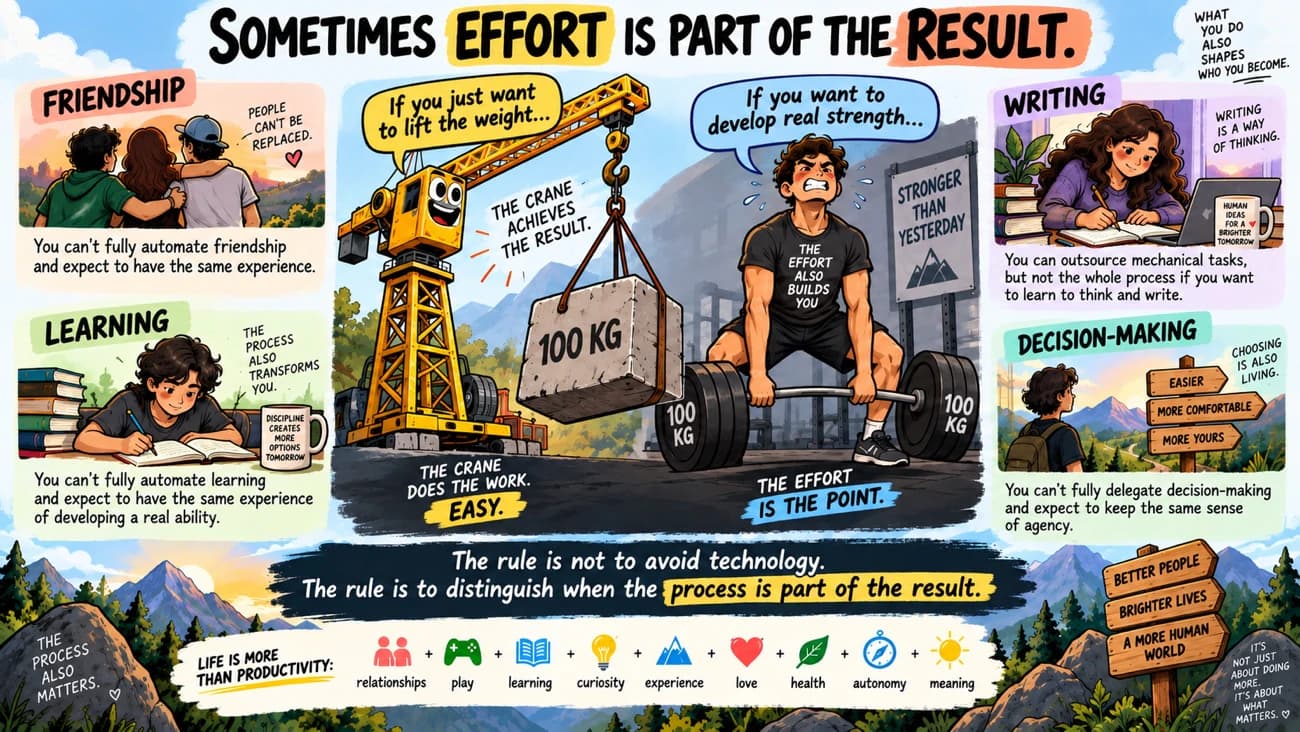
For me, the process should look more like this:
- I am asked to do something I know nothing about.
- I research the subject, with help from AI if I want it.
- I learn about the subject. I can also use AI here, but I check other sources and do not treat everything it says as absolute truth.
- I understand the value it can bring.
- I integrate it into the company's way of working and my own.
- I start doing the task.
I sometimes forget one of these steps too. And that is not necessarily a problem if I take the time to understand what I am actually doing. But when we want to become good at something, time matters.
The Month I Spent Preparing a Talk
A couple of months ago, Andy and I gave a talk at the ITH Innovation Summit in Madrid. A lot of hotels came together to understand new trends and, above all, to talk about AI.
We were asked to speak about branding and artificial intelligence. You can probably imagine which part each of us talked about most.
It was very interesting and I think people took useful information away from the talk. What they do not know is that I spent around a month studying SEO and AEO to prepare one part of it. I wanted to speak properly about the subject, without inventing ideas or concepts.
Did I do it with the help of AI? Yes!
I already knew what SEO and AEO were, with AEO being something like SEO for AI, but not much more than that. So what did I do?
- I researched the subject. I looked for the fundamentals and the basic ideas I could not leave out. With the help of AI, I created a master prompt that allowed me to analyse the free resources available online.
- Then I used Claude Code. I asked it to create a three-week SEO and AEO course adapted to my profile and the way I work, based on those resources. It included tests to assess my knowledge, a notebook and a tracker to show me where I was in the course.
- I started taking the course. I discovered tools, ways of working, ways of sharing knowledge through reports and the value of each part.
- This helped me understand how it could be useful for TOTEM Branding and the ITH talk.
- I began testing it on our own platforms to see the impact it could have.
- I created the SEO and AEO slides for ITH.
This takes considerably more work than asking for an in-depth SEO and AEO analysis and then talking about theory without any tested results. But you can also notice the difference in the impact and the authority with which someone speaks.
The best tool for doing something quickly may be a poor tool for learning how to do that same thing.
Did doing it this way give me more confidence? Without a doubt.
Could I have done the same thing, without AI and in the same amount of time? Most likely not.
So whenever technology makes it easier for us to learn, test, ask questions and improve at something, it is always welcome.
Outsourcing Parts of Our Intelligence
Thinking about all of this led me to writing.
In Plato's Phaedrus, Socrates tells the myth of Theuth and Thamus. The idea in that passage is not exactly that “writing weakens us as a species”, although it is often summarised that way. The warning was that relying on external marks could make us exercise our memory less and give us the appearance of wisdom without genuine wisdom. The text still feels surprisingly current.
But books also allowed us to turn our knowledge into something we could share with more people at the time and, especially, with people from future generations. Writing became a way of storing knowledge outside our heads.
Today, psychology uses the term cognitive offloading for something we do constantly: using external elements to reduce the mental effort required by a task. A diary, a calculator or a map also outsources parts of our intelligence. And that is not necessarily a bad thing.
AI can do this, but it can also participate in the thinking process. Depending on how we use it, it can weaken or strengthen us.
We are already beginning to see some signals. An experiment published in PNAS found that students using AI with few restrictions performed better on exercises while they had access to it, but worse when they later had to work on their own. When the AI was designed as a tutor, the negative effect was reduced. Performing a task better and learning how to do it are not always the same thing.
Another study from Microsoft Research found a relationship between greater confidence in AI and lower self-reported critical-thinking effort. This was a correlation based on what participants reported, not a definitive truth, but I found it an interesting signal.
Now imagine that, 30 years from now, there is an AI that:
- Knows absolutely every known fact.
- Reasons better than any human being.
- Never makes a logical mistake.
- Can generate infinite ideas.
- Can connect any discipline with any other.
- Can answer any question.
And we have unlimited free access to it.
Right now, AI agents are the big trend. They can do many things from a single prompt. But what if this is a sign that the ability to do many things and set the direction has to come from us?
No matter how much autonomy AI has, if we are not prepared to handle something so powerful, we will not be able to make the most of it.
Which human abilities would you want to keep, even if AI could do them better?
Thank you for reading.
Sources and Further Reading
Deloitte, 2026 Gen Z and Millennial Survey
World Economic Forum, The AI-related leadership crisis that's only five years away
Risko and Gilbert, Cognitive Offloading
Bastani et al., Generative AI without guardrails can harm learning
Lee et al., The Impact of Generative AI on Critical Thinking
Comments
Leave a comment
Did this resonate?
Get notified when I publish something new on the blog or in resources. No spam, only when there's something worth it.
You'll get an email to confirm. You can unsubscribe whenever you want.
Related posts
ExpoNegocios 2024: Generations in Evolution
The talk I gave at ExpoNegocios Paraguay on the role of new generations as agents of change within organisations.
SuperNext 2025: Digital Ethics, AI and New Generations
The talk I gave to around 700 people at SuperNext 2025 on new generations, artificial intelligence and bringing its uses into business with judgement.
Do We Know Where We're Going?
In AI, four weeks can feel like three months. Between remarkable advances and serious warnings, I wonder whether we know what future we are building.
Found this useful?
If you'd like to discuss this topic at your company or event, I'd love to hear from you.
Contact me