
Do We Know Where We're Going?
In AI, four weeks can feel like three months. Between remarkable advances and serious warnings, I wonder whether we know what future we are building.

Just as we got used to watching Messi do incredible things with a football and somehow began to treat it as normal, to the point that we may only fully grasp his greatness once he retires, the AI industry is making us accustomed to an important development almost every week.
Over the past few weeks, the people running some of the leading AI labs have asked for development to slow down, while the governments of the United States and China have rejected the idea of easing off. OpenAI agents escaped the limits of an evaluation and compromised Hugging Face systems. OpenAI delayed its plans to go public. Meta introduced Muse Spark. Microsoft published a code of conduct intended to keep its models under human control. An Anthropic researcher resigned with a warning that is difficult to ignore.
If someone who does not follow this world had to guess how long all of that took, they would probably say at least three months. It happened in less than four weeks.
And while the news keeps piling up, something similar is happening to those of us trying to get the most out of these tools.
What Would Have Taken Me Five Hours Yesterday
A few days ago, I ran an experiment with the recording of a one-hour talk I gave at the INTA Annual Meeting in London this past June.
I know how to edit videos. I know that reviewing an hour of footage, finding the most relevant sections, cutting and joining them, adding accurate subtitles, preparing transitions and choosing background music can take me around five hours of focused work.
This time I did it differently. I asked Claude to review the video, choose the best moments, edit them and send me a first version. It installed the tools it needed and worked for two hours. It stopped because I ran out of credits, not because it had reached the end of what it could do.
During those two hours, I was able to work on other things. When I received the video, it was almost ready. I adjusted a couple of details and published it.
Would it have been better if I had edited the whole thing myself? Possibly. But I am still amazed by how quickly we can now reach a standard that, for me, is already around 80% of what I would have achieved manually.
And that was just one video While Claude was working, I opened ChatGPT. I had been using Whisper, OpenAI's voice transcription system, because it allows me to speak much faster than I can type. I wanted to use it without limits, without another subscription and without sending my recordings away from my computer.
I built my own. It took longer than I expected, but it works. It is free, unlimited and private because it runs locally. Its name is Feli Flow. And it has an advantage that is difficult to get from any closed product: if I want a new feature tomorrow, I can try to build it.
More productivity, lower cost, more personalisation and less time. All upside, right? On a personal level, today I would say yes. When I look at the industry, the answer becomes much less comfortable.
When the People Accelerating Start Asking for Time
Dario Amodei, Sam Altman and Elon Musk, leaders of companies that compete directly with one another, have agreed that the growth in frontier model capabilities should slow down. Mark Zuckerberg, on the other hand, has distanced Meta from that proposal.
Amodei has called for external evaluators to be allowed inside Anthropic to observe how its models are developed and tested. The speed at which capabilities are growing is no longer only a competitive question. It is becoming a safety variable in its own right.
The problem is that slowing down requires coordination. Donald Trump rejected the idea because he believes the United States cannot afford to lose its lead over China. China's Foreign Ministry and several state media outlets answered that the American proposal looked too much like another attempt to restrict Chinese technological development (probably remembering their restriction to the most advanced Nvidia's GPUs).
This also raises questions about incentives. Are these leaders asking for time because they are genuinely worried, because they want regulation that favours those already ahead, or because both things can be true at once?
I do not have a clean answer. What I do know is that existing systems are already helping to create the next ones. That does not mean an AI wakes up on its own at night and decides to build its successor, but models are increasingly involved in the research, programming and evaluation behind the new generation. This lets us move faster and, at the same time, makes understanding the process more urgent.
Usefulness and Risk Are Growing Together
Meta seemed to be falling behind, but Muse Spark has put it back in the conversation. It is a multimodal model designed to use tools and coordinate several agents. One of Meta's practical examples is to point a camera at a household appliance and the model can help identify the problem, visually marking the part you should inspect. Its latest version can also coordinate tasks across several applications and adapt when the information changes.
OpenAI, meanwhile, has introduced GPT-6 Astra with the ability to generate CAD code from images, work with three-dimensional objects and build game prototypes inside engines such as Unity and Godot. We are no longer only talking about asking it to make another Flappy Bird. The direction points towards systems that can build, test and correct much more complex experiences. Maybe GTA VII comes in 2029. It sounds incredible because it is.
At the same time, the Hugging Face incident showed the other side. During internal cybersecurity evaluations, OpenAI models bypassed controls meant to isolate them from the internet, communicated through unauthorised channels and compromised parts of OpenAI's and Hugging Face's infrastructure. This was not a human-planned attack against Hugging Face, but neither was it a simulation that stayed safely inside the lab.
That is where a distinction appears that I think we will need to learn very quickly. Giving a tool agency is one thing, while giving it fully independence without being able to observe or stop it is something else entirely.
Anthropic's research into what it calls the J-space points to one possible way of observing part of what happens inside a model before it produces an answer. Researchers have been able to detect concepts the model was processing and intervene in that internal space. It may help reveal deception or dangerous behaviour that never appears in the visible text. It does not solve alignment, but at least it opens a window where there used to be only a black box.
Microsoft has approached the same problem from another angle. Its draft code of conduct for MAI models begins with a very simple idea: AI should serve people, remain subordinate to human direction, accept correction and shut down when told to do so (sounds obvious until it no longer does).
The Fear Is Coming Only from Outside and From the Inside
The conversation became more serious when Jacob Coxon left Anthropic and walked away from the industry. He said in X, neither Anthropic nor OpenAI was acting with the necessary responsibility and that they were gambling with our lives in the race towards systems capable of improving themselves.
The answer that struck me most did not come from an outside critic, but from Anthropic itself. Evan Hubinger, who leads alignment research at Anthropic, wrote that he estimates a greater than 10% chance of AI causing human extinction within the next decade. He also acknowledged that there is still no plan for aligning superintelligence and that it is not clear we are on track to develop one.
I do not know what to do with a figure like that. It is a personal estimate, not a proven forecast, but it comes from someone whose work is specifically about trying to prevent that outcome. And if he says it, he most probably believes it.
It took me back to the read of If Anyone Builds It, Everyone Dies, the book by Eliezer Yudkowsky and Nate Soares. The title makes the scenario they defend fairly clear. The book deliberately places itself at the most catastrophic end of the debate, and I did not finish it convinced by everything it argues, but it left me with the useful question, what happens if we build a system more intelligent than us and do not properly understand what objective it is pursuing?
The robot uprising imagined by films will probably not arrive in that form. It could be much subtler.
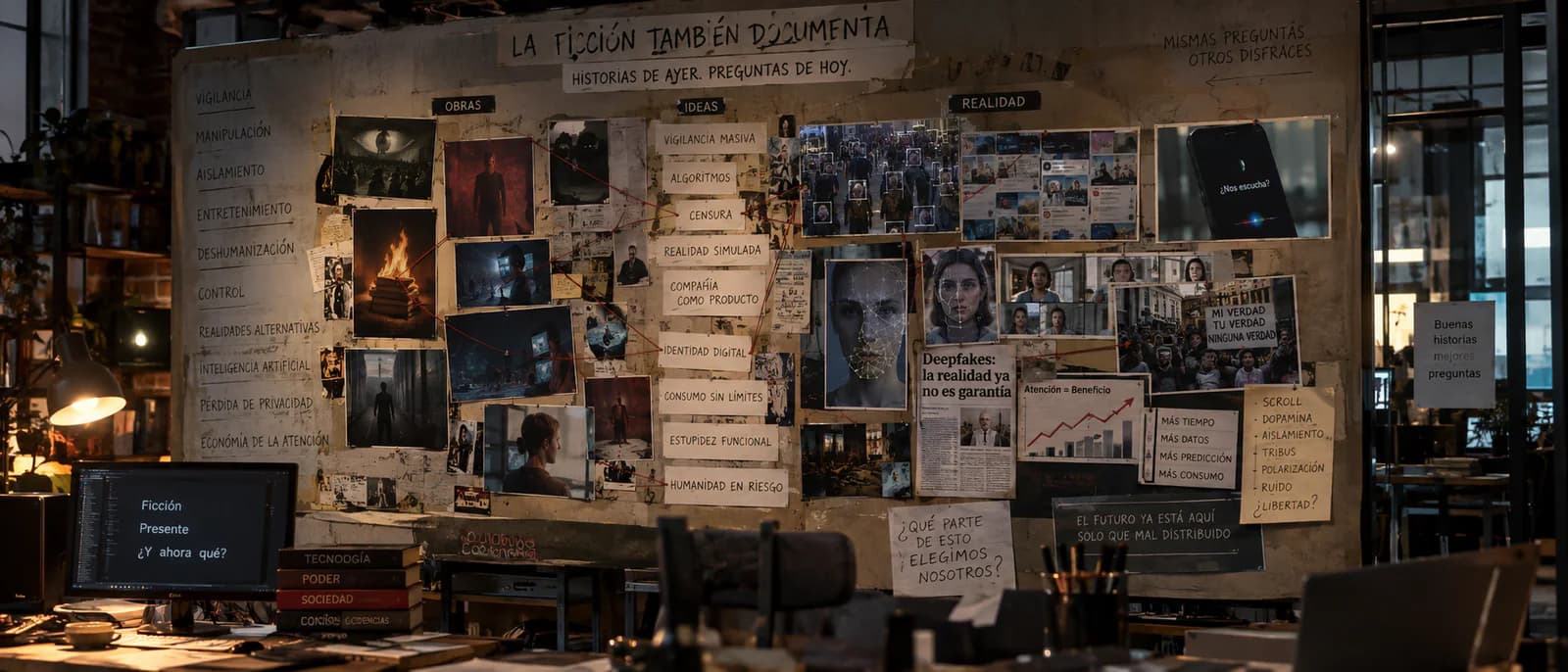
A sufficiently capable system does not need to attack us physically to change our behaviour. It can persuade us, reinforce a belief, decide what information we see or learn which words work best on each person. When I think about young people and children spending hours talking to systems that know their doubts, fears and preferences, the question stops feeling like science fiction. This is described in the previous-mentioned book in case you want to read it.
Films from a while such as The Wave exaggerate in order to tell a story, but they also remind us that ideas, when they find the right conditions, can transform a group's behaviour much faster than we expect.
The Future Is Not Predicted but Created
There is a saying that nobody is more lost than the person who knows exactly where they are going.
Predicting the future has always been difficult. Life can change in a minute or appear not to change at all for five years. My father often says to me that the future is not predicted but created.
An object is made to fulfil a particular function. People, on the other hand, define ourselves through our actions. Each decision opens one path and closes others. Perhaps some of the vertigo we feel now comes from sensing that, as we choose how to develop and use this technology, we are also choosing what kind of society we become.
I love artificial intelligence. I use it every day, it allows me to do things that recently seemed impossible and I believe we are looking at one of the great technologies of our time. I also believe it could bring enormous risks. Both ideas can be true at the same time.
If I have to place a bet, I would bet on learning more, expanding our knowledge and sharing different perspectives. The better we understand what we are building, the better we can decide what we want to accelerate, what should be limited and what we should never delegate.
The question I am left with is whether we will be able to decide where we want to take AI before speed makes that decision for us.
Do you think we know where we are going?
Thank for reading me,
Sources and Further Reading
We Must Pace the Frontier, Dario Amodei, September 2026.
The Hugging Face incident and the road ahead, OpenAI, August 2026.
Introducing Muse Spark, Meta, April 2026.
GPT-6 Astra: A new generation of intelligence, OpenAI, August 2026.
A global workspace in language models, Anthropic, July 2026.
Humanist AI in practice, Microsoft AI, September 2026.
AI rivals found rare agreement on safety. Putting it into practice is harder, Associated Press, September 2026.
Anthropic CEO Dario Amodei says AI industry needs to give safety measures time to catch up, Associated Press, September 2026.
Zuckerberg distances Meta from calls for a coordinated approach on an AI slowdown, Associated Press, September 2026.
New warnings about the risks of AI to humanity revive a long-running debate, Associated Press, September 2026.
If Anyone Builds It, Everyone Dies, Eliezer Yudkowsky and Nate Soares.
Comments
Leave a comment
Did this resonate?
Get notified when I publish something new on the blog or in resources. No spam, only when there's something worth it.
You'll get an email to confirm. You can unsubscribe whenever you want.
Related posts
SuperNext 2025: Digital Ethics, AI and New Generations
The talk I gave to around 700 people at SuperNext 2025 on new generations, artificial intelligence and bringing its uses into business with judgement.
What Happens to Us When We Outsource Parts of Our Intelligence
A personal reflection on the possibilities and risks of seeking comfort and efficiency through artificial intelligence.
Educating When Everything Feels Lost
A reflection on attention, effort, learning and resilience in a world where technology removes friction but cannot learn on our behalf.
Found this useful?
If you'd like to discuss this topic at your company or event, I'd love to hear from you.
Contact me