What Young People Should Do With the Rise of AI
Junior roles are most exposed to AI disruption. Not being self-taught is no longer just a disadvantage: it can leave you behind in ways that simply didn't exist before.
I've been thinking about something for a while that I think matters, and that I don't think is being said clearly enough.
The deeper I get into artificial intelligence, the more I see a pattern repeating itself. Companies are learning to do more with fewer people, and I'm not saying that as a hypothesis: I see it in conversations with executives, in hiring data, in how new teams get structured. What used to require five people can now take two with the right tools, and those two people aren't the youngest on the team, they're the ones with more judgment, more context, more accumulated experience to make decisions under uncertainty.
That has direct consequences for those of us just starting out, and I think it's worth talking about honestly.
Junior roles are the most exposed
There's something I find uncomfortable to admit but that I think is real: the most dispensable profiles right now are entry-level ones, interns, juniors, people learning by doing. Not because they're less valuable as people, but because a lot of the tasks that used to be their way into the job market can now be done by AI faster and with fewer mistakes.
This isn't doom-mongering, it's the same logic that's played out with every technological shift: when spreadsheets arrived, there was less work for people doing calculations by hand; when the internet arrived, a lot of information intermediaries disappeared. The difference this time is that the change is faster, broader, and touches more types of work at once, which makes the systems meant to prepare young people for work even slower relative to the technology that already exists. And that's exactly where I think the most important gap shows up.
Being self-taught stopped being an advantage and became something more urgent
For a long time, learning on your own, seeking out resources, training outside the institutional path, was valued as a differentiating quality that put you a step ahead. But the world we're living in now has changed that framework fairly radically.
Before, if you weren't self-taught, you simply didn't have that extra edge. You went to school, to university, did what you were told you had to do, and that was enough to fit into a job market that changed more slowly than it does now. Today I think not being self-taught can become a real problem, not because institutions are wrong or useless, but because the speed at which tools, models, and ways of working develop is infinitely greater than the speed at which curricula get updated. If you're not able to find your own sources, find mentors, and adjust what you learn to your goals and your level of understanding, part of the world is simply going to stay off your radar, even if you're doing everything you're supposed to do.
I'm not saying there aren't brilliant teachers, fully updated courses, or communities that stay current, because there are. But we can't rely only on someone else finding them for us.
AI as a tool for learning, not for avoiding learning
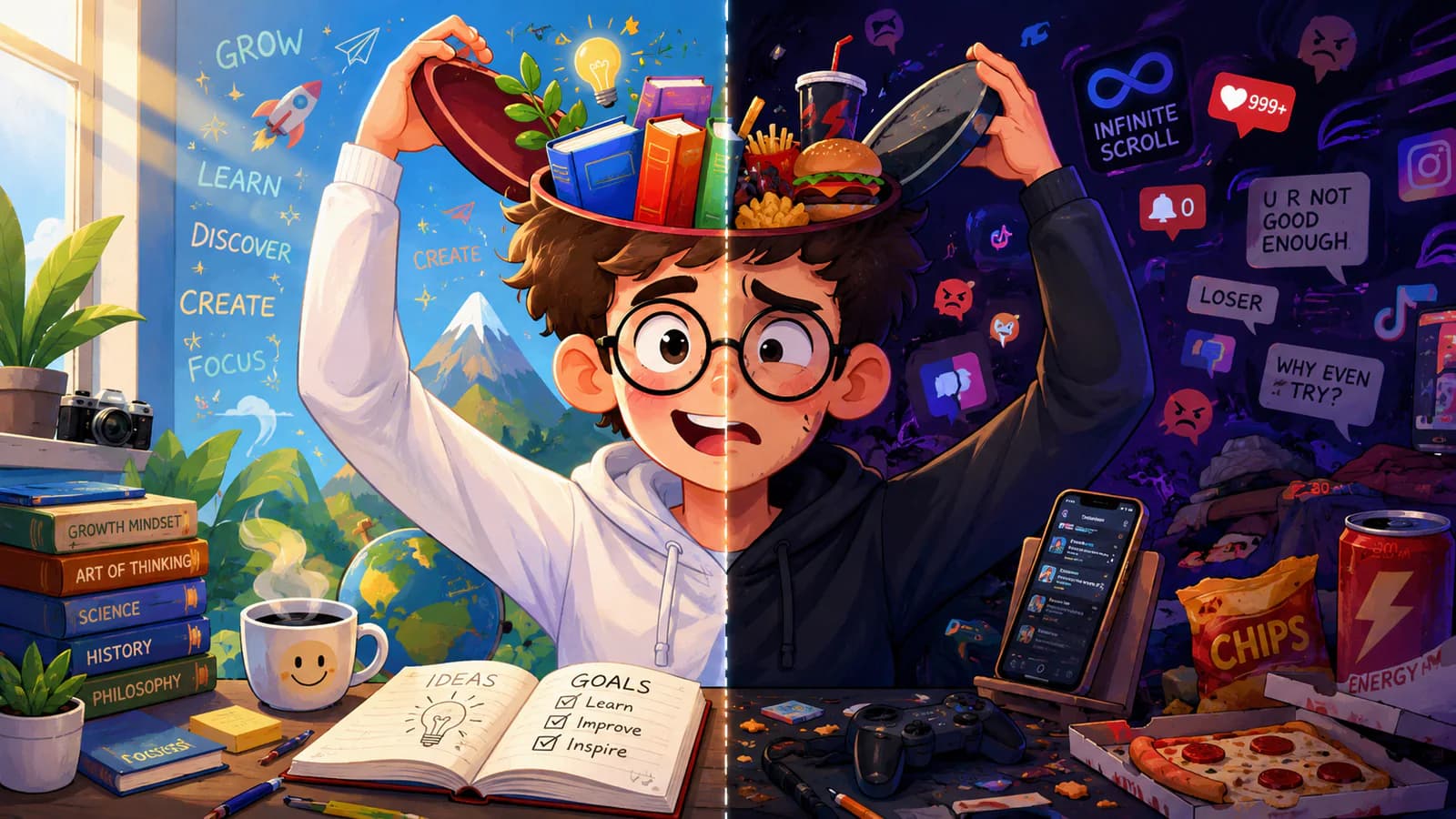
I think the most dangerous temptation right now is using AI to avoid having to think: if you have to write something, you ask it; if you have to learn something, you ask for the summary; if you have to solve something, you hand it the problem and copy the solution. The result is an illusion of productivity that doesn't actually build anything, and I understand it completely because I fall into that too sometimes, and the temptation exists precisely because the tool works so well.
But there's a completely different way to use AI, and that's using it to learn faster and better than before.
I've been going to the gym for almost three months now, one of the few times in my life I've actually managed to stay consistent, and one of the reasons it's worked is that every time I have a doubt about technique, about an exercise, or about how to adapt something to my goals, I ask. I don't outsource everything to AI or stop thinking for myself, but when I don't know something specific I have immediate access to an answer that helps me keep moving with judgment instead of getting stuck. That same pattern works exactly the same way in the professional world: AI is extraordinarily good at explaining concepts you don't know, not like a search engine handing you links but like someone who adapts the explanation to what you already know, moves at the pace you need, and lets you go as deep as you want. That potential is enormous and I think we're still massively underusing it.
It's not about being techie
Something I think is important to clarify is that making the most of all this doesn't require knowing how to code, or knowing by heart which model is best for which task, or following every AI account on social media. It requires curiosity, patience, and a willingness to iterate, get things wrong, and dig into something even when it's hard, because the barrier to accessing a hyper-personalized learning tool has never been lower in history. Anyone with internet access can now have something very close to a private tutor available twenty-four hours a day, fully adapted to their level and interests, and the question that's left is what each person decides to do with that.
What I think makes the difference
I don't have a fixed formula, but I do have a fairly clear intuition about what type of person is going to find their place in this landscape: the one who doesn't wait to be told what to learn, who seeks out their own sources and picks their own references, changing them as they grow, who uses AI to understand better rather than to avoid understanding, and who can hold onto their own judgment when the tool fails, gets something wrong, or oversimplifies. That's not something you get from an intensive weekend course, it's something you build over time, through conversations, through projects that go wrong, and through constant iteration.
This technology keeps surprising me week after week, and I think that capacity for wonder combined with the willingness to dig in even when it's hard is exactly what we most need to cultivate right now, not so we don't fall behind, but so we can build something that depends more and more on ourselves.
I go into more detail on how this translates into concrete skills in what I've learned to do with AI that I used to think would take years.
Comments
Leave a comment
Did this resonate?
Get notified when I publish something new on the blog or in resources. No spam, only when there's something worth it.
You'll get an email to confirm. You can unsubscribe whenever you want.
Related posts
Educating When Everything Feels Lost
A reflection on attention, effort, learning and resilience in a world where technology removes friction but cannot learn on our behalf.
The window is closing: OpenAI, Google and Anthropic signed the same letter on the same day
More than 100 organizations that compete with each other signed the same warning about AI-enabled cyberattacks. What it says, why now, and what it means for your company.
The best way to learn is by doing
There is no shortage of AI courses and guides, but they expire fast. Why being self-taught went from unusual to essential, and what five months at the gym taught me.
Found this useful?
If you'd like to discuss this topic at your company or event, I'd love to hear from you.
Contact me