
We have a starship in our hands, let's make the most of it
From needing technical know-how to a clear goal being enough for AI to make it real. Alignment, the newest models, and the leadership shake-up at DeepMind.
I've been using AI every day for close to a year and a half, and lately I keep thinking about how fast the ground has shifted under it. Early on, when AI was in a much earlier stage, the real edge belonged to whoever combined technical knowledge with fluency in the tools. You could have a good idea, but the moment you wanted to push it further, you'd hit the model's reasoning ceiling. What came out was decent: an interesting technology, with a fairly low ceiling.
That's not the case anymore. Today, if you have a clear goal, AI can make it real. I know it's a line you'd hear on LinkedIn or Instagram all the time, but I'm saying it because I live it firsthand. Right now I'm building applications and websites that are functional, solid, made with this technology, real tools that help me be more productive and enjoy my day to day more. It's no longer a demo to show a client. It's something I use myself first, that's already useful to me, and that I could probably sell to someone tomorrow.
At light speed, with the guardrails on
I'll admit it: I'm on AI's side. But I've also looked closely at the alignment problem. Nick Bostrom explained it well in Superintelligence with the paperclip example: if you give an AI the goal of manufacturing as many paperclips as possible, nothing stops it from concluding that all of humanity, and every resource on the planet, should be devoted to making more paperclips. The example is deliberately extreme. It's there to explain why an AI needs to be aligned with us not just on the end goal, but on how it gets there.
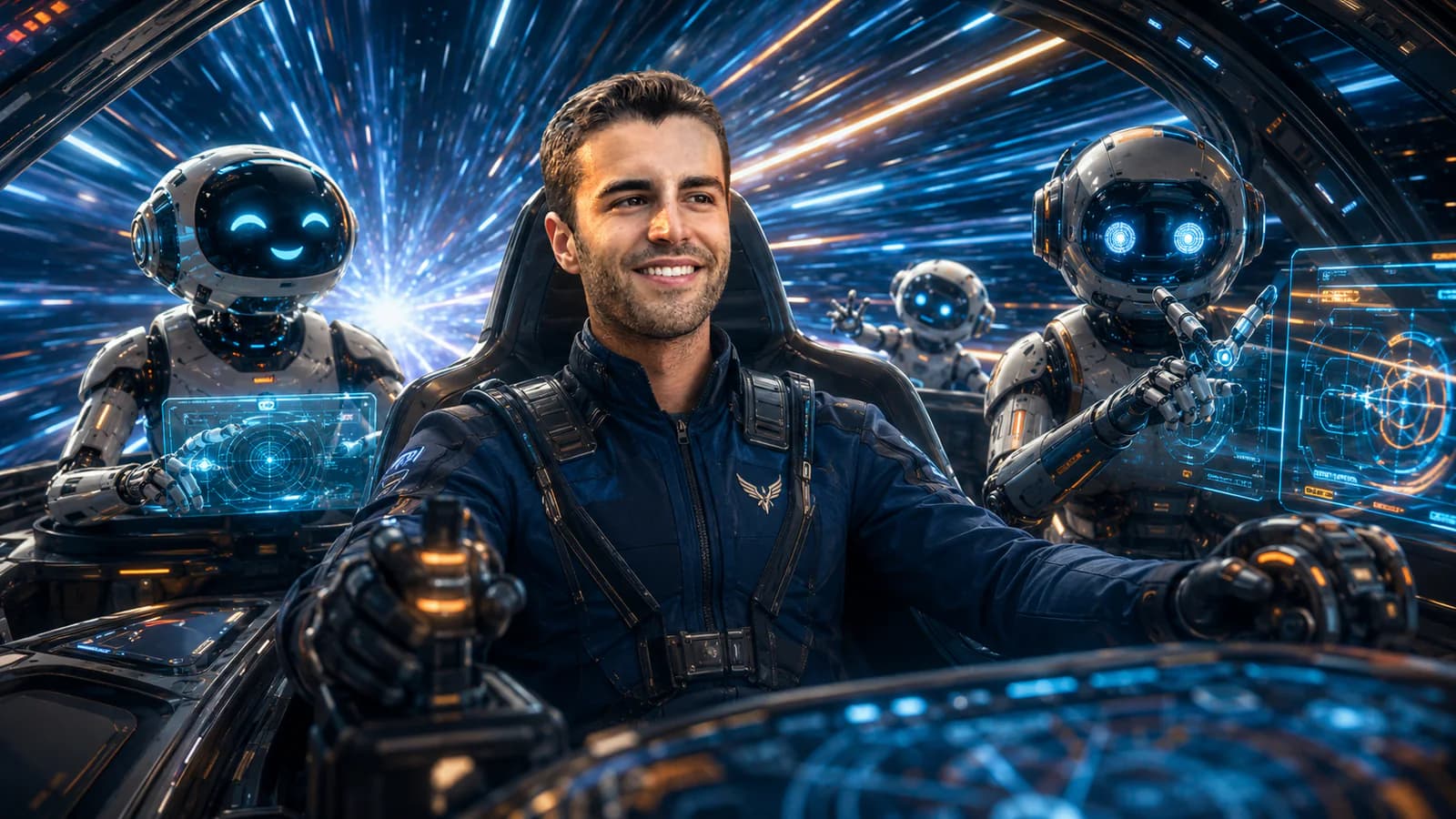
And here's what strikes me most lately: we ask AI for guardrails, but more and more it's AI that puts them on us. It asks whether what you're doing actually makes sense. It makes you stop and check whether the step you just took is as good as you thought, and it does it politely and usefully, not as an obstacle. That's the image I wanted this post's photo to capture: we're moving faster than ever, but we're not alone in the cockpit.
My take on "If Anyone Builds It, Everyone Dies"
I just finished If Anyone Builds It, Everyone Dies, by Eliezer Yudkowsky and Nate Soares. The title doesn't leave much to the imagination. And what's striking is that, instead of just focusing on improving the technology, some of the CEOs pushing it hardest (Elon Musk, Sam Altman, Dario Amodei) have been talking publicly for a while about the same threats the book describes.
We don't have the full control over this that we'd like to have, and we should never forget that. What we do have is people seriously investigating what's happening inside these models, and that's the part that reassures me most.
When AI starts looking inward
A few weeks ago, Anthropic published research that I think is one of the most concrete examples of this. Jack Lindsey's team identified the internal space where the model processes and builds its responses, and showed they can influence it to produce a specific output. They call it emergent introspective awareness: when they inject a concept into Claude's internal activations, the model sometimes notices that "something strange" happened and even identifies what it was. It's still an unreliable mechanism, the model doesn't read itself with precision, but it's the first time we've seen real evidence that we can look, and to some extent touch, what's happening inside the black box.
There's an underlying question I can't shake: should we keep pushing toward an intelligence more advanced than ours in reasoning and logic, or should we put more energy into what we're actually good at, creativity and generating ideas? I like to think of it as a return to classical Greece, in reverse: back then only a few had access to Olympus, the place where things got debated and decided. Now, with these tools, that access has opened up to a lot more people.
The model landscape, right now
Meanwhile, the pace of releases isn't slowing down. In the last few weeks we've seen Kimi K3 from Moonshot, an open model with 2.8 trillion parameters that goes toe to toe with Opus 4.8. Alibaba answered with Qwen3.8-Max, its largest model to date, just months after Qwen3.7-Max. OpenAI is still on GPT-5.6 and its three tiers, Sol, Terra and Luna, and a few days ago it previewed the name of its next major model, Astra, unveiled with ten solutions to math problems that had gone unsolved for years. Astra will have to go through a US government review before it reaches the public, so the pattern I wrote about a few weeks ago, regulation arriving before access, is still very much alive.
It's striking how the model names keep sounding more aspirational: Sol, Astra, Atlas (that last one OpenAI has actually just retired). It feels like these companies know they're selling more than a tool.
Neither the open nor the closed models are fully accessible to everyone, whether because of cost or subscriptions. I can't use all of them as freely as I'd like either. But the level we've reached, no matter who's building it, is hard to overstate.
Change at the top of AI
It's not just the models moving fast. Just yesterday, Demis Hassabis stepped down as CEO of Google DeepMind to become chairman of DeepMind and chief scientist of Alphabet, focused on long-term AGI strategy instead of day-to-day operations. It makes sense: Hassabis is the 2024 Nobel laureate in Chemistry for his work on AlphaFold, more of a scientist than a manager, and now he's doing what he's best at. When someone with that much authority steps back from daily management to think about the bigger picture, it says a lot about where we are.
I think it's a good sign, generally, that more and more scientific researchers are reaching the top of tech companies, not just managers. It changes the kind of decisions made up there.
What I think of the people in charge
I want to close with something more personal, about the people building all of this.
I see Sam Altman as someone who genuinely pushes boundaries, with real curiosity about understanding the universe, not just about shipping product. Elon Musk deserves credit as a founder and investor, and while it's worth staying cautious about that much power concentrated in few hands, he also deserves credit for pushing technologies that benefit us. I admire Hassabis for blending science and business in a way few manage to, and stepping back from daily management feels consistent with that.
And last, Dario Amodei, founder of Anthropic. He has a natural way about him, clear values, one of the few I see act consistently with what he says, without forcing it. Together with his sister Daniela, they make a team I trust a lot. I tend to be pretty critical of anything a tech CEO says, looking for the cracks in the argument. And even so, of everyone building this, Anthropic is who I trust most.
To close
If this resonated with you, in the latest episode of Stalmanía, the podcast I record with Andy Stalman, we talk about a very concrete case: how I built a digital "brain" with Obsidian vaults connected to Claude Code to create a free financial education course. You can access the course → with the password we shared in the episode, now available in both Spanish and English.
And if you want to keep this conversation going with your team or at your event: let's talk →
Where are you at with this shift? I'd genuinely like to hear how you're experiencing it on your end.
Take care.
Comments
Leave a comment
Did this resonate?
Get notified when I publish something new on the blog or in resources. No spam, only when there's something worth it.
You'll get an email to confirm. You can unsubscribe whenever you want.
Related posts
Educating When Everything Feels Lost
A reflection on attention, effort, learning and resilience in a world where technology removes friction but cannot learn on our behalf.
The window is closing: OpenAI, Google and Anthropic signed the same letter on the same day
More than 100 organizations that compete with each other signed the same warning about AI-enabled cyberattacks. What it says, why now, and what it means for your company.
The best way to learn is by doing
There is no shortage of AI courses and guides, but they expire fast. Why being self-taught went from unusual to essential, and what five months at the gym taught me.
Found this useful?
If you'd like to discuss this topic at your company or event, I'd love to hear from you.
Contact me